153 — Node.js, The Documentary (Ryan Dahl, Async I/O, io.js, Foundation)
Full companion narrative for CultRepo's Node.js documentary — Ryan Dahl's async bet, the community and npm explosion, the io.js fork, and foundation governance
Video: 153 · Node.js: The Documentary | An origin story | ~62:48 film | watch · CultRepo
Source: this is a written companion to the video. Part of the Favorite TypeScript Videos curated path, module 00 (foundations) — the history behind the tool: 152 teaches the runtime as it is, and this film explains how it got there. Forward, 154 returns to practice with a typed production setup.
“In 2009, like, interactive websites and stuff was basically non-existent.” The documentary’s arc runs from Ryan Dahl’s frustration with blocking server frameworks to a foundation-governed platform running a large share of the web. The beats are technical (async I/O), social (npm, modules, conferences), and political (the fork, the foundation) — each necessary, none sufficient alone.
the bet: non-blocking I/O on a single thread
“You start thinking about Ruby on Rails, why is that slow?” Dahl’s question found its answer in the event loop: one thread, async filesystem and network calls, callbacks instead of blocked workers. The readFile example in the lesson material is the whole philosophy — start the work, register the continuation, never wait.
// the bet: start the read, continue on callback, never block
const fs = require("fs");

fs.readFile("example.txt", "utf8", (err, data) => {
	if (err) throw err;
	console.log(data);
});
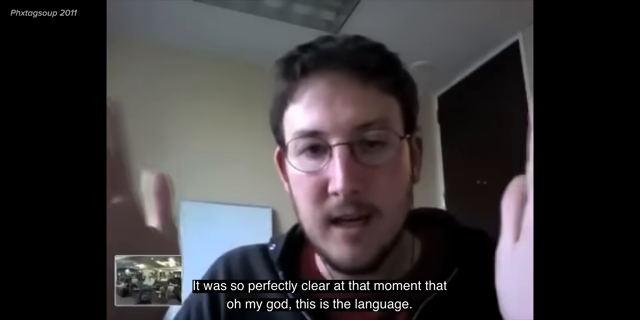
the proof: hello world on a socket
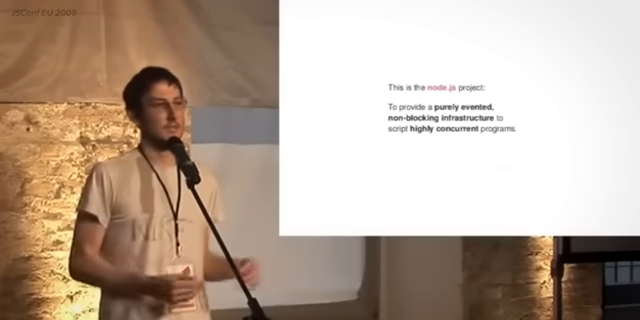
The canonical server — six lines from require('http') to listen — is the artifact the film keeps returning to: the demo Dahl gave on conference stages, including the Scala EU 2009 appearance the frames capture. Same primitive 152 teaches; here it is a historical object, the moment the bet became demonstrable.
// the demo that made the bet visible
const http = require("http");

http.createServer((req, res) => {
	res.writeHead(200, { "Content-Type": "text/plain" });
	res.end("Hello, World!\n");
}).listen(3000, "127.0.0.1");

console.log("Server running at http://127.0.0.1:3000/");
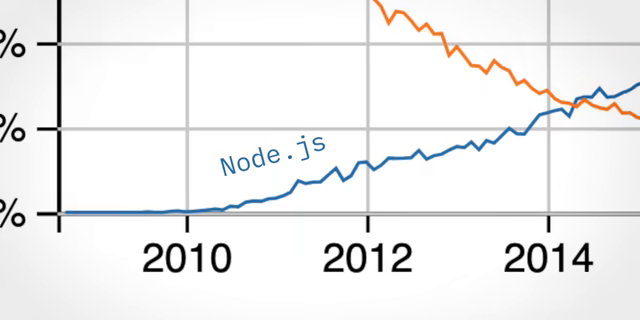
the compounding: npm and the module graph
“It did build on my machine.” The npm story is candid about rough edges, but the registry turned isolated users into a compounding ecosystem — every published module made the next project cheaper. The greet module example stands for millions of such small shared units, and the growth chart (Node rising 2010 to 2014 against a fading rival) quantifies the compounding.
// the unit of compounding: one shared module
module.exports = {
	greet: function (name) {
		return `Hello, ${name}!`;
	},
};
the governance: fork, then foundation
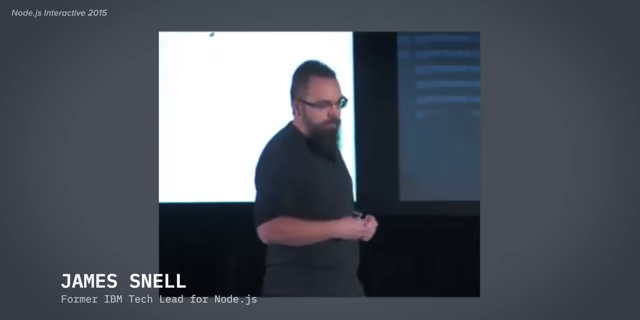
“So a lot of us have been very involved in that.” The io.js fork forced the governance question, and the Node.js Foundation answered it — the film’s closing beat, voiced by the people who lived it (including the Node.js Interactive 2015 stage the final frame captures). Technology won the argument; institutions kept the win.
// the ecosystem grown up: CLI tooling on shared infrastructure
const program = require("commander");

program
	.version("1.0.0")
	.command("hello <name>")
	.description("Print a greeting")
	.action((name) => {
		console.log(`Hello, ${name}!`);
	});

program.parse(process.argv);
The historical center of the Node run: backward it deepens 152’s runtime tour with origins, forward it motivates 154 (production discipline for the platform the film built) and 155 (the framework layer the ecosystem enabled). Its community-compounding theme echoes 151’s DefinitelyTyped history.
Prev: 152 — What Is Node.js · Next: 154 — TypeScript Setup for Node.js
Transcript notes: Quotes (“In 2009, like, interactive websites and stuff was basically non-existent.”, “You start thinking about Ruby on Rails, why is that slow?”, “It did build on my machine.”, “It’s actually really cool.”, “So a lot of us have been very involved in that.”) verified against the transcript segments; the server, readFile, module, and CLI snippets verified against the narrative’s concept blocks. Screenshot refs cover 5 sampled frames in order (source frames 1, 7, 11, 30, 56): frame-0001.png (conference stage) through frame-0005.png (Interactive 2015) across the ~62:48 runtime — a documentary, so frames are stages, interviews, and slides rather than editor sessions.