052 — #18 Never Type in TypeScript | TypeScript Basics & Data Types | A Complete TypeScript Course
The lecture introduces `never`: a return type meaning the function will not return anything, ever — not even `undefined`. Setting `never` on the ordinary `greetUser` function errors ("a function returning never cannot have a reachable end point") because it can fall off the end; setting it on `createError(message: string, code: number)`, which `throw`s an error object instead of returning, compile
Video: 052 · #18 Never Type in TypeScript | TypeScript Basics & Data Types | A Complete TypeScript Course · watch · ~09:25 · procademy
Source: this is a written companion to the video. Part of the Favorite TypeScript Videos curated path.
The lecture introduces never: a return type meaning the function will not return
anything, ever — not even undefined. Setting never on the ordinary greetUser
function errors (“a function returning never cannot have a reachable end point”)
because it can fall off the end; setting it on createError(message: string, code: number), which throws an error object instead of returning, compiles fine.
The observable difference: logging a void call prints undefined, while logging
a never call prints nothing at all — the throw happens first. Two practical notes
close it out: never must be written explicitly (an unannotated throwing function
is inferred void), and infinite-loop functions are the second canonical never
case.
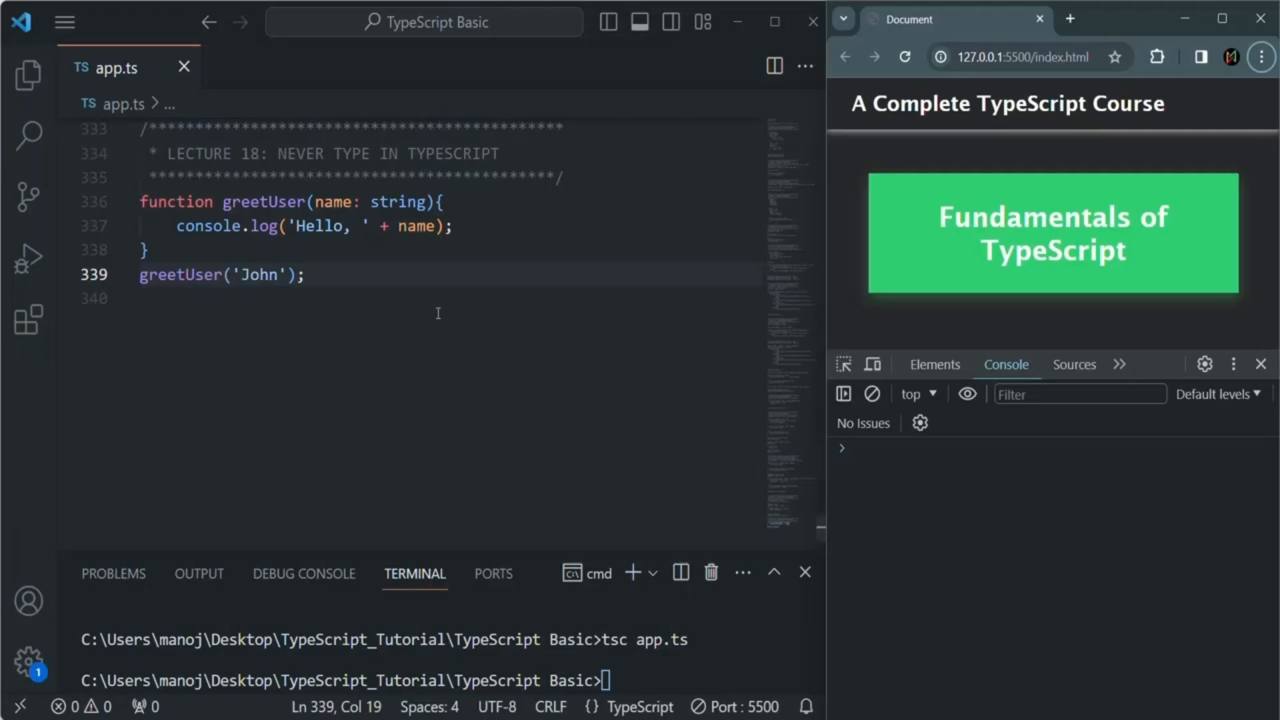
never means no reachable end point
Setting greetUser’s return type to never errors — hovering reads “a function
returning never cannot have a reachable end point.”
function greetUser(name: string): void {
	console.log("Hello " + name);
}
greetUser("John"); // Hello John
greetUser returns nothing but can reach its end, so its honest type is void.
never promises stricter: the end is never reached.
The throwing function — createError
function createError(errorMessage: string, errorCode: number): never {
	throw { message: errorMessage, code: errorCode };
	// console.log(errorMessage); // unreachable — never runs
}
The function only throws — anything after the throw never runs because the function
exits immediately. Calling createError("Internal server error", 500) compiles
cleanly, logs “Hello John” from the earlier line, then surfaces the thrown
{ message, code } object as an uncaught error (thrown, not returned).
Observable difference — void logs undefined, never logs nothing
console.log(greetUser("John")); // Hello John, then undefined
console.log(createError("Page not found", 404)); // throws; logs nothing
Logging a void call prints undefined; logging a never call prints nothing, because
the throw happens first. The recap: void at least returns undefined, while never
never returns at all. The demo even needs the earlier throwing calls commented out
first, since a throw stops everything after it
never must be explicit; infinite loops qualify too
Without an explicit annotation, a throwing function’s return type is inferred as
void — never must be written out.
function infinite(): never {
	while (true) {
		// keeps iterating infinitely — never returns
	}
}
A while (true) loop that iterates forever is the second canonical never case:
the function never returns, so never is its honest return type. Closing rule: use
never for the return type of a function that is never going to return.
Transcript corrections applied above: void (not white, wide (return type)); greetUser (not
great user, greed user, create user); comment out this code/call (not commend this code/call); app.ts file (not sub.ts file); while loop (not y loop); never type (not
nevertype); console.log statement (not console.logstatement).
Prev: 051 — #17 Unknown Type in TypeScript | TypeScript Basics & Data Types | A Complete · Next: 053 — #19 Configuring TypeScript Compiler | Configuring TypeScript Compiler | A Complete TypeScript Course