029 — You Don't Know JavaScript (the why-types motivation)
Full companion narrative for You Don't Know JavaScript — float rounding, coercion, == vs ===, semicolon insertion, null vs undefined, and string sort as the case for static types
Video: 029 · You Don’t Know JavaScript · watch · ~22:59 · The PrimeTime (reaction/commentary format over a scripted “senseless features” piece)
Source: this is a written companion to the video. Part of the Favorite TypeScript Videos curated path, module 01 (fundamentals — the why-types motivation). Reaction format: the host pauses a scripted essay to riff, so conceptual claims track the underlying piece; asides are host opinion.
the case for static types, told as comedy
This is the “why types” motivation video wearing a comedy costume. Every quirk it tours — float rounding, coercion, == vs ===, silent semicolon insertion, null vs undefined, string-sort — is a runtime surprise that TypeScript’s static checking exists to catch. Closing punchline, verbatim: “use a tool like TypeScript … that does static analysis to improve your code quality.” Mine it for cautionary examples, not for API teaching.
floating point is IEEE 754, not JavaScript’s fault
The tour opens with 0.1 + 0.2 !== 0.3 and immediately defuses the mockery: JavaScript merely implements the IEEE 754-1985 floating-point standard that nearly every language and CPU uses. Fixed-point vs floating-point is visualized on slides — 8-bit fixed point: range collapses to 0–15.9375 when the imaginary point is fixed; 8-bit float: range 0.0078–480 but with unrepresentable gaps.
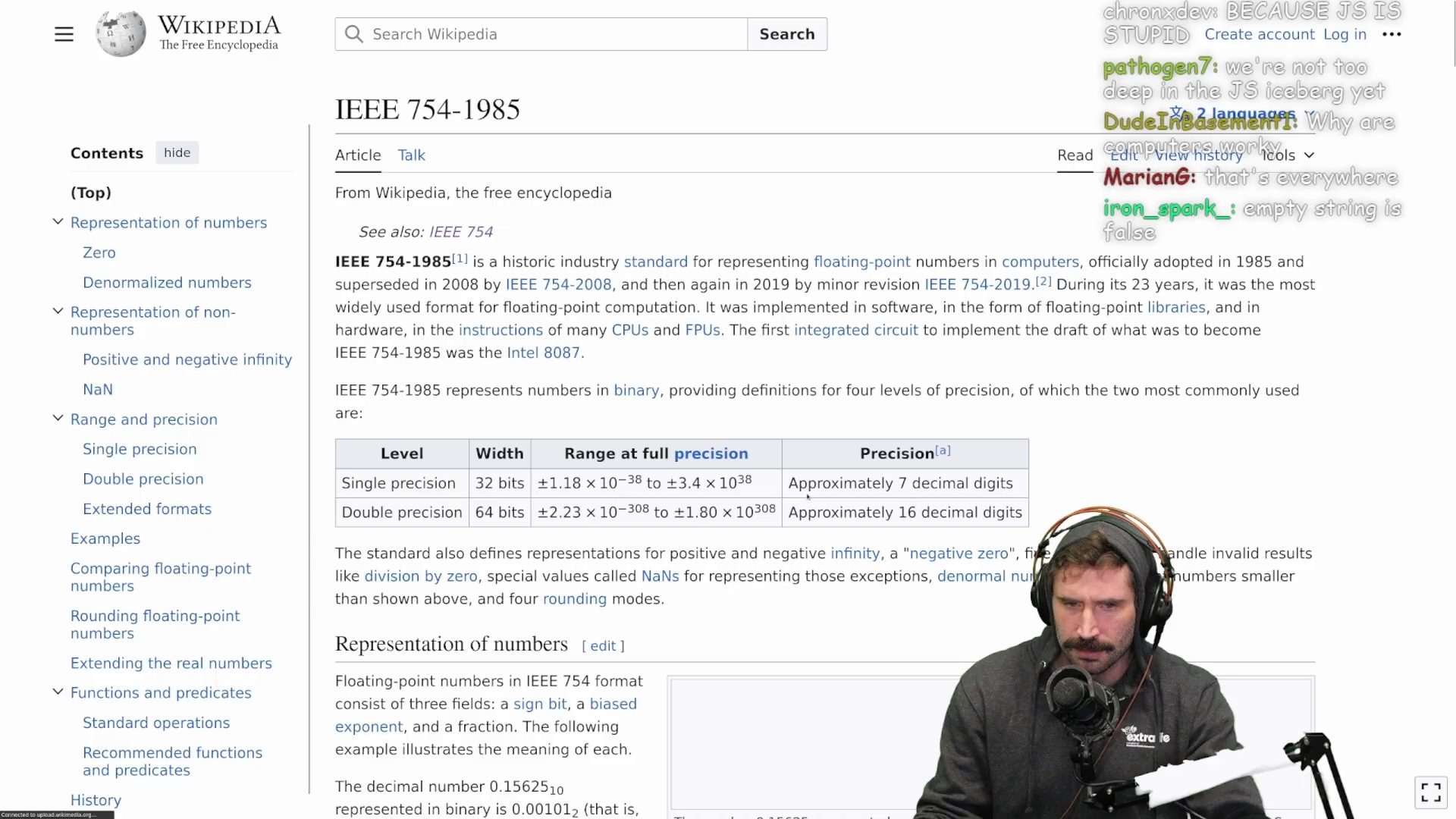
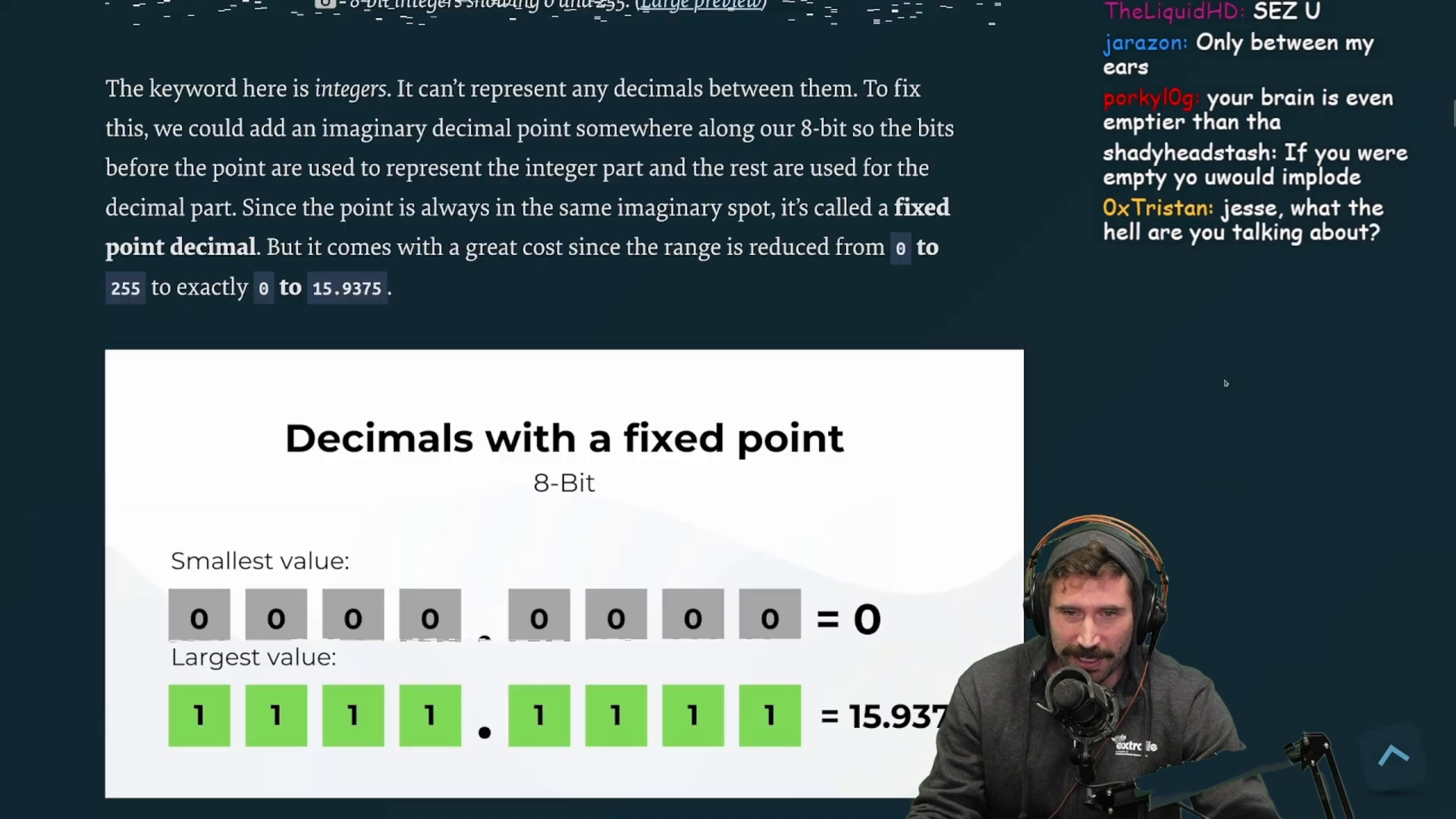
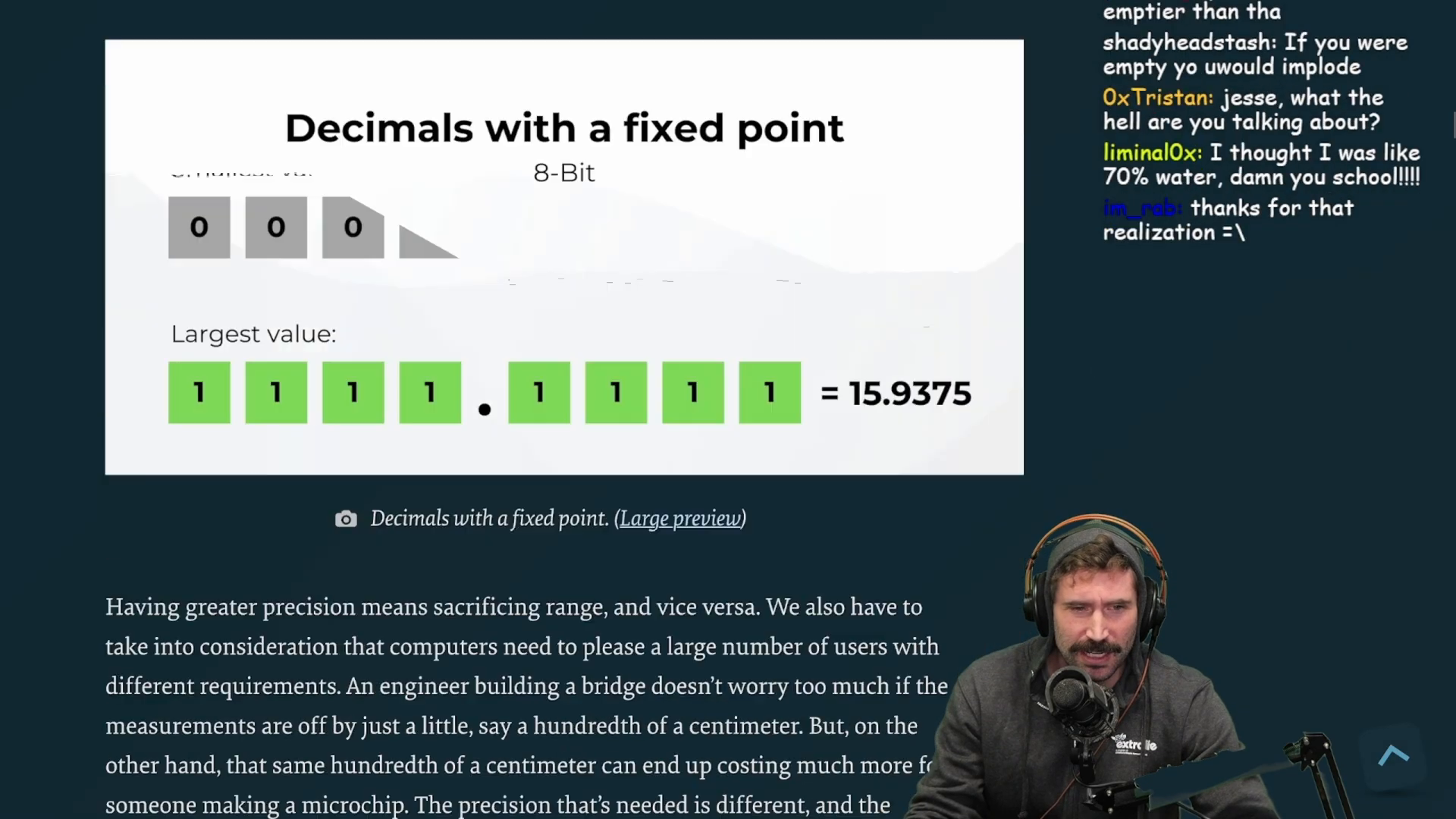
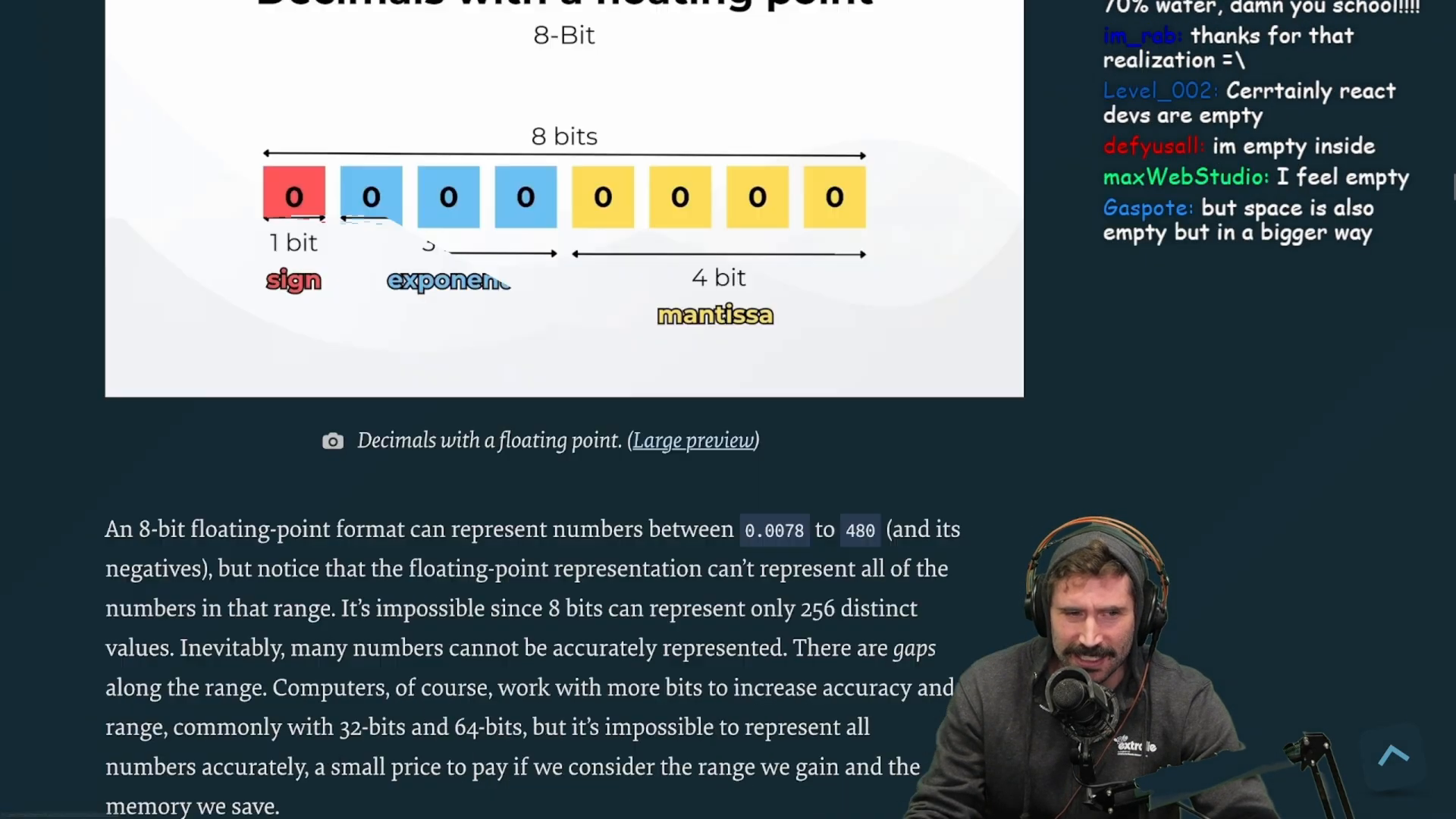
Takeaway: decimal imprecision is a representation tradeoff shared across languages — the fix is awareness plus integer math or decimal libraries, not language-shaming.
0.1 + 0.2; // 0.30000000000000004 — IEEE 754, every language does this
0.1 + 0.2 === 0.3; // false
type coercion: + concatenates, == converts
JavaScript is dynamically AND weakly typed: no declared types, plus implicit conversion between them. Two operators carry most of the blame. The + operator coerces numbers to strings when either side is a string (so string concatenation via + is fragile — prefer template literals or String.prototype.concat); the == loose-equality operator coerces across types ("1" == 1 is true). The demo const a = "1"; let b = 1; b++ + +a bit plays the plus-sign pileup for laughs, then lands the rule: only use + when sure both sides are numbers.

const a = "1";
let b = 1;
"1" == 1; // true — loose equality coerces
"1" === 1; // false — strict equality, no coercion
why two equality operators: a 10-day design compromise
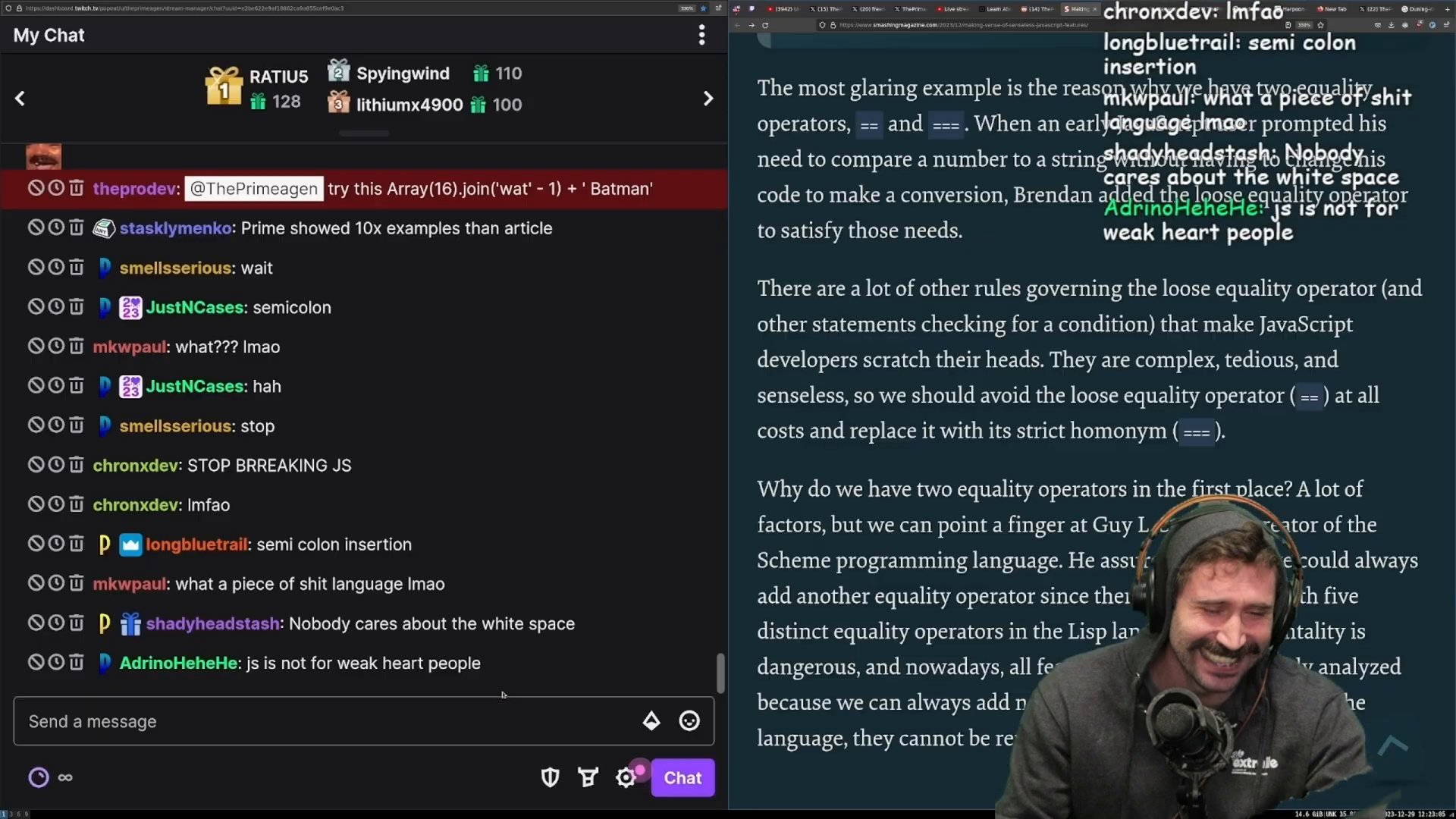
The history is the lesson: Brendan Eich built the language in roughly 10 days, early adopters asked to compare numbers to strings without manual conversion, and loose == was added to satisfy them. Guy L. Steele’s “you can always add another equality operator” (Lisp had dialects with five) is cited as the dangerous mentality — features can be added but never removed. The presenter’s own confession: null == undefined is true, the one loose comparison he is “always tempted to use” for “either null or undefined” checks. Rule banked: avoid == at all costs; the complexity of its rules is the argument for strictness.
automatic semicolon insertion is not reliable
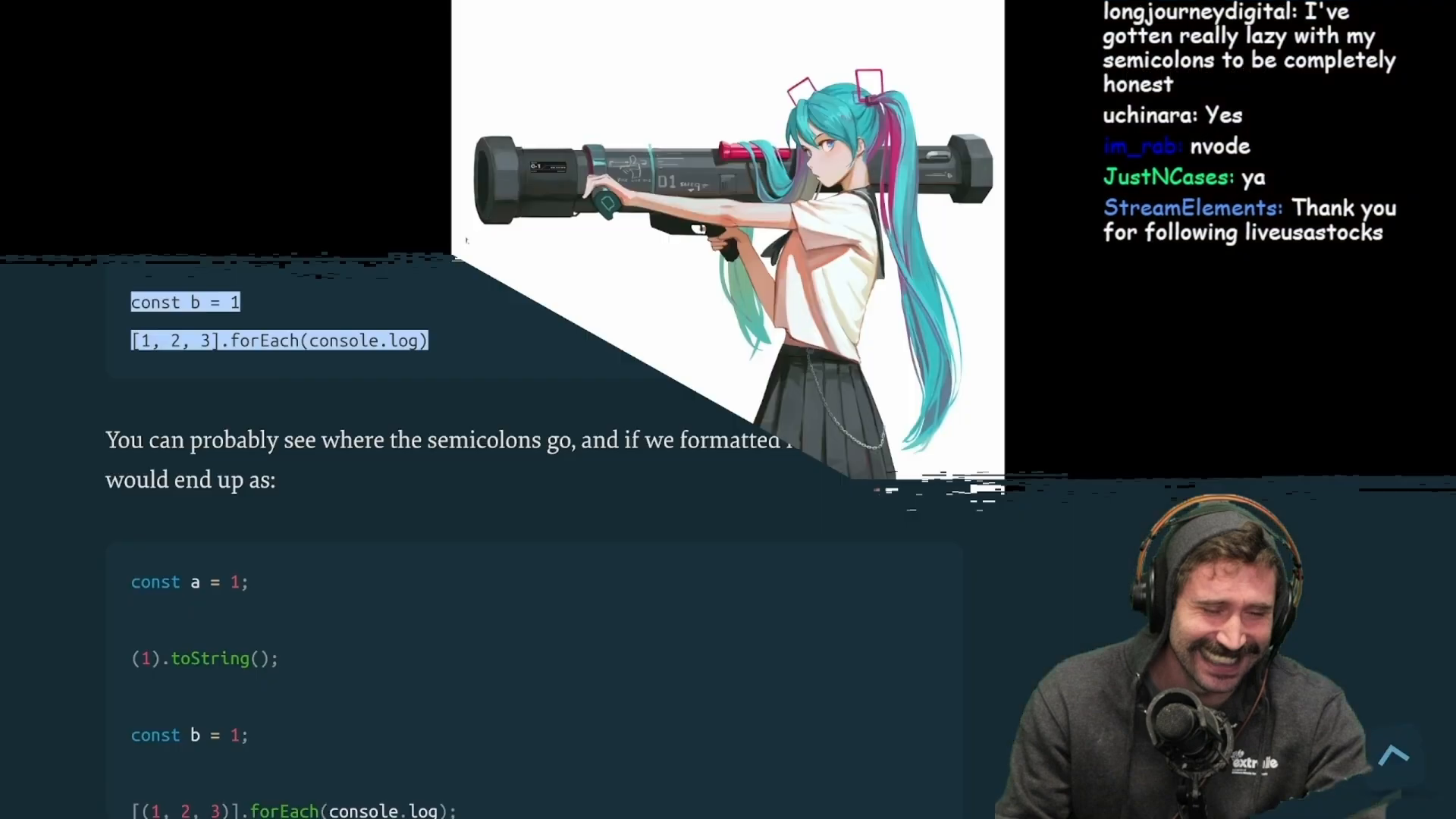
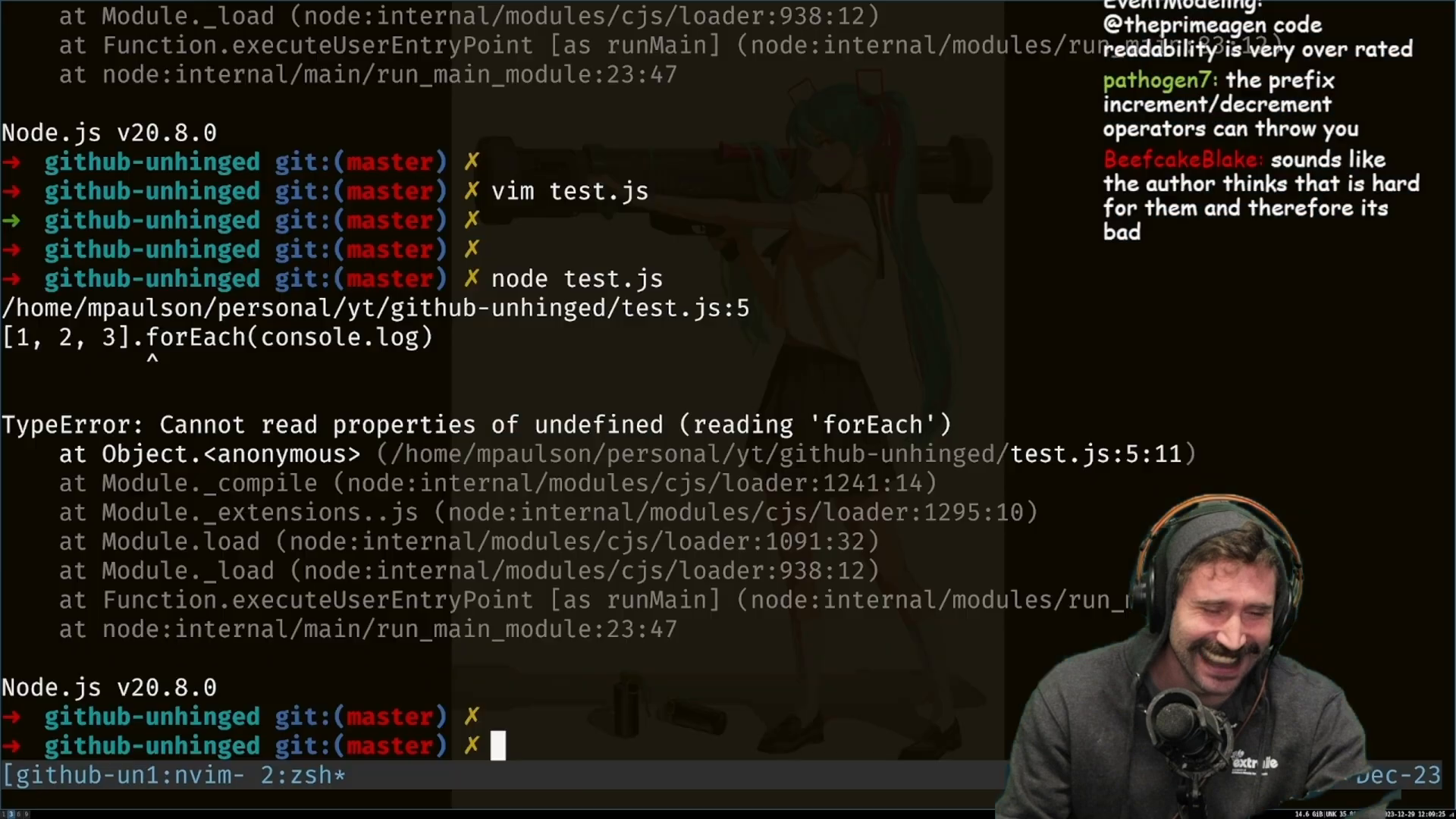
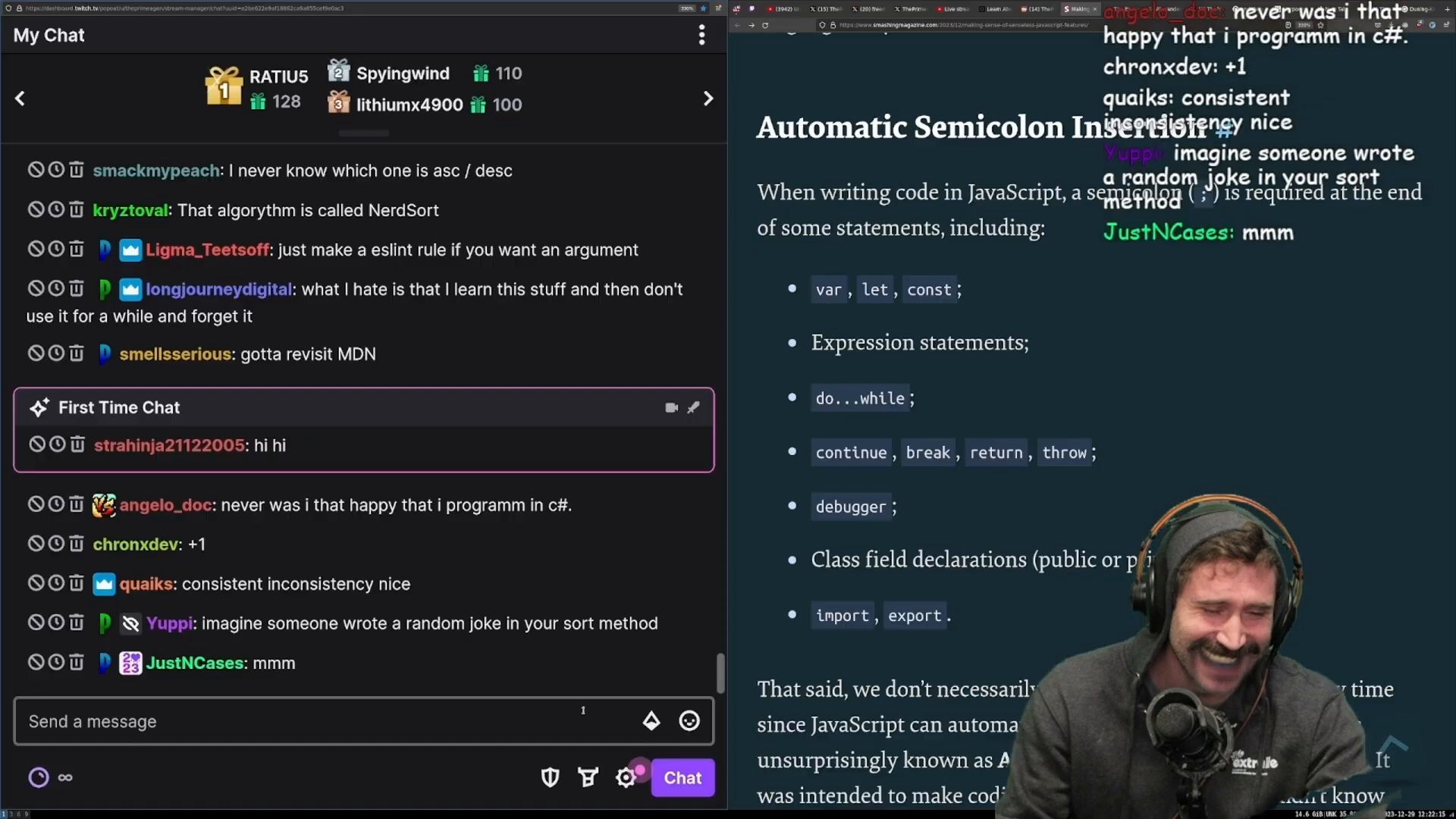
ASI (automatic semicolon insertion) was meant to help beginners who omitted semicolons, but it is not a reliable feature: feeding unformatted code directly to the engine throws ([1,2,3].forEach after a missing semicolon becomes “1 is not a function” — the parenthesized line is parsed as a call). The return-newline case gets special attention: a line break after return inserts a semicolon, so the function returns undefined — whitespace is significant exactly there. The presenter’s rule is absolute: always write semicolons explicitly.
function foo() {
	return;
	5; // ASI inserts ";" after return — returns undefined, not 5
}
two bottom values (null, undefined) plus NaN
Everything is object-like except null and undefined (despite typeof null === "object", property access on either throws TypeError — the “path problem” behind the ?. optional-chaining operator). The roles differ: undefined is the language’s own default (uninitialized variables), null marks deliberate ends (notably the prototype chain’s end); Object.create(null) makes a prototypeless object while Object.create(undefined) throws. NaN is the third bottom: a failed string-to-number conversion result that is not equal to itself, tested with Number.isNaN. The abundance of bottoms is judged a design error with no clean justification.
typeof null; // "object" — the famous lie
null.property; // TypeError: Cannot read properties of null
NaN === NaN; // false — test with Number.isNaN instead
Array.prototype.sort coerces to string by default
The closing gotcha: default sort() converts every element to a string, so [-4, -3, 17, 77, 100] sorts lexicographically into nonsense. Numeric order requires an explicit comparator ((a, b) => a - b, reversed as (a, b) => b - a). The presenter wishes sort required the comparator argument — and notes toSorted inherits the same behavior, so the trap survives into the new API.
[-4, -3, 17, 77, 100].sort(); // lexicographic — wrong for numbers
[-4, -3, 17, 77, 100].sort((a, b) => a - b); // [-4, -3, 17, 77, 100]
Prev: 028 — Inheritance in JavaScript: Prototypal Inheritance · Next: 030 — 100+ JavaScript Concepts You Need to Know
This video motivates but teaches no TypeScript; every rule here becomes a tsc payoff later. Transcript corrections: mantissa, Brendan Eich, OCaml, nullish (??), Deno, Vite, ESLint. The 1993 creation-year claim is the video’s own as spoken — retained, not silently “fixed."